
You have a great clinic. Your team is experienced, your equipment is up to date, and your patients love you. But when someone in your city types “dentist near me” into Google, your practice doesn’t show up.
That’s the problem SEO solves.
I’m Raghav Dua. Since 2019, I’ve helped 100+ businesses improve their rankings, generate leads, and grow revenue through SEO, PPC, website development, and digital marketing. In that time, I’ve worked with dozens of dental clinics across India, the UK, and North America. The clinics that grow predictably share one thing: they invested in dental SEO early and treated it as infrastructure, not a one-time fix.
This guide covers everything you need to know about SEO for dentists — from the fundamentals to advanced local SEO strategy, from Google Business Profile to dental website design. Whether you’re just starting out or you’ve tried SEO before without results, this is the practical playbook.
What is SEO for Dentists?
SEO (Search Engine Optimisation)me”, for dentists is the process of making your dental practice visible in search engines like Google when potential patients search for services you offer.
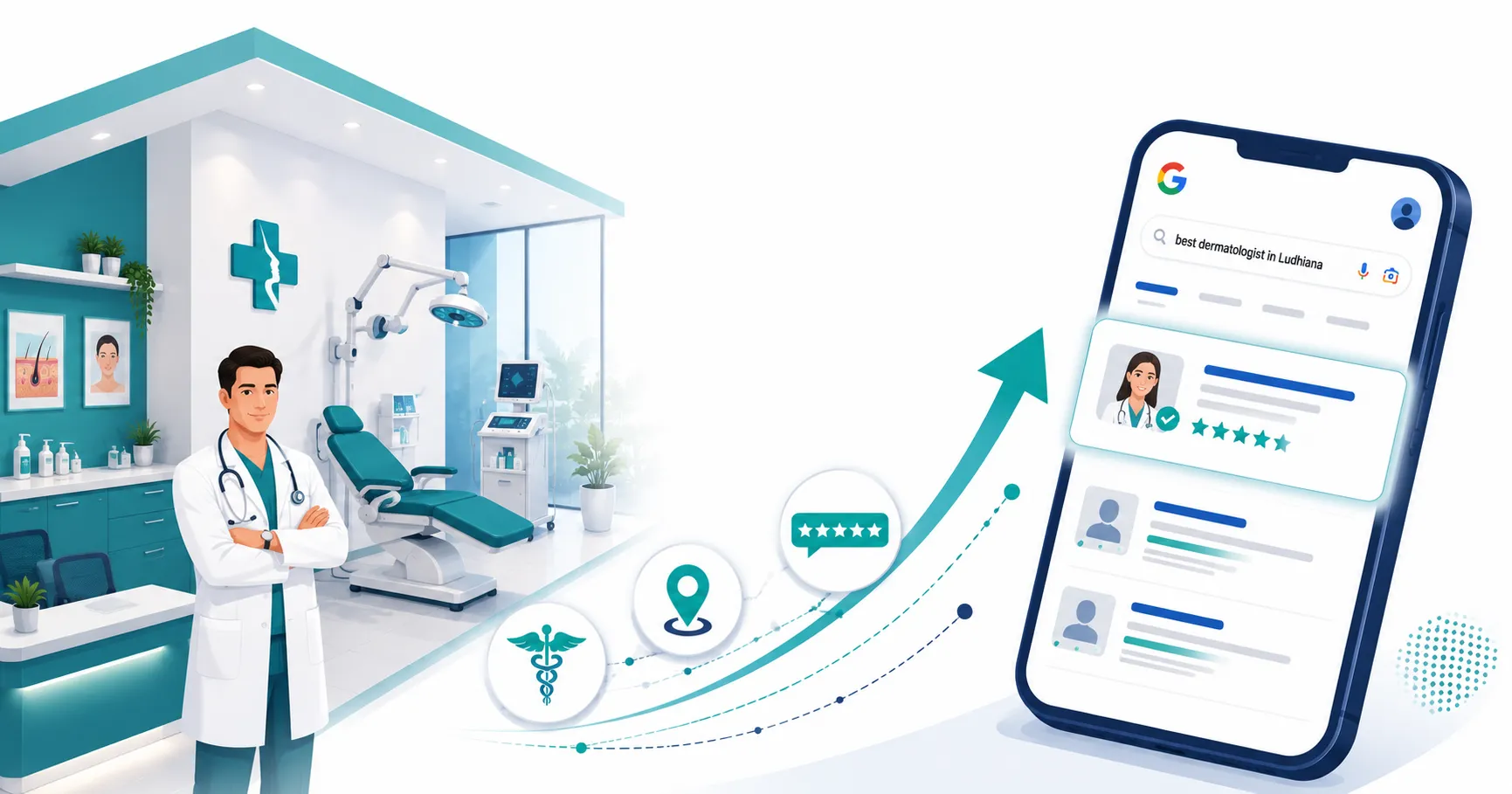
When someone types “dental implants in [city]” or “emergency dentist near me,” Google returns a list of results. SEO determines where your clinic appears in that list. The higher you rank, the more clicks you get, and the more new patients book appointments.
Dental SEO specifically involves:
- Optimizing your website for keywords patients use
- Building and managing your Google Business Profile
- Getting listed in local directories and citation sites
- Earning reviews and managing your online reputation
- Creating content that answers patient questions
- Building links from trusted dental and local websites
It’s different from paying for ads. SEO trafficorgaorganic; you earn it through relevance and authority, not daily budgets.
Why SEO Matters for Dental Practices
Search is where patients start. According to Google, 77% of patients use online search before booking a healthcare appointment. For dentistry, that number is even higher for high-value services like orthodontics, dental implants, and cosmetic procedures.
Here’s what I see consistently when I audit dental clinic websites: most clinics are invisible for the searches that matter most.
They might rank for their own name. But they don’t appear when someone searches “teeth whitening [city]” or “family dentist near me”. Those are the searches with real booking intent — people who are ready to choose a provider right now.
The clinics that dominate local search share a few traits:
- They have complete, verified Google Business Profiles
- Their websites load fast on mobile and have clear service pages
- They have 50+ recent Google reviews with consistent ratings
- They appear in Google Maps for multiple dental service keywords
- They publish consistent, helpful content
If your competitors have those things and you don’t, they’re taking your patients every day.
The Real Benefits of Dental SEO Services
| Benefit | What It Means in Practice |
|---|---|
| Consistent patient flow | Organic rankings bring in leads every day without ad spend |
| Lower cost per patient | SEO leads cost less long-term than Google Ads |
| Trust and authority | High rankings signal credibility to new patients |
| Compound growth | Good SEO gets stronger over time |
| Local dominance | Appear in Maps for every service you offer |
| Better website experience | SEO improvements make your site faster and clearer |
| Higher appointment booking rates | Targeted content brings in patients with real intent |
The ROI on dental SEO compounds. A Google Ads campaign stops the moment your budget runs out. An SEO ranking you earn in month 6 keeps delivering in month 18.
Step-by-Step SEO Strategy for Dental Clinics
Step 1: Audit Your Current Position
Before changing anything, know where you stand.
Run a quick audit:
- Search “[your city] dentist” and note where you appear (or don’t)
- Check your Google Business Profile for completeness
- Test your website speed on Google PageSpeed Insights
- Count your current Google reviews and check your average rating
- Search for your top 3 services (e.g., dental implants, teeth cleaning, braces) and see if your website appears
During SEO audits I run for new dental clients, I almost always find the same issues: duplicate service pages, no geo-targeted content, missing schema markup, and Google Business Profiles with outdated hours or photos from 2019.
Once you know your baseline, you can track real progress.
Step 2: Keyword Research for Dental Practices
Dental keyword research isn’t about finding the most-searched terms. It’s about finding the terms your ideal patients use when they’re ready to book.
High-intent keywords (prioritise(prioritise these):
- “dental implants [city]”
- “emergency dentist [city]”
- “Invisalign provider near me”
- “teeth whitening cost [city]”
- “family dentist accepting new patients [city]”
- “dentist near me open Saturday”
Informational keywords (
- “how much do dentacost?”lants cost”
- “what to expect during a root canal”
- “how often should I visit the dentist?”
- “are clear aligners as effective as braces?”
Service + location combinations are your most valuable targets. A page titled “Dental Implants in [City]” with the right content will outrank a generic “Dental Services” page every time.
Tools worth using: Google Keyword Planner (free), Ahrefs, Semrush, or Ubersuggest. For local keyword research, look at Google’s autocomplete and “People also ask” sections; they show exactly what patients in your area search for.
Step 3: Optimize Your Dental Website
Your website is the foundation. Rankings without conversions are pointless, and conversions without rankings mean no traffic. You need both.
Technical SEO basics:
- Site speed under 3 seconds on mobile (use Google PageSpeed Insights to check)
- Mobile-first design (60%+ of dental searches happen on phones)
- HTTPS encryption (a ranking signal and a patient trust signal)
- Clean URL structure:
/dental-implants-delhi/not/page?id=17 - Properly formatted title tags and meta descriptions for every page
- Schema markup for LocalBusiness, Dentist, and FAQPage
On-page SEO for service pages:
Each dental service you offer should have its own dedicated page. Don’t combine crowns, bridges, and veneers into one page called “Restorative Dentistry”. Build individual pages for each.
Every service page needs:
- The primary keyword in the H1, first paragraph, and URL
- Location mentioned naturally throughout the content
- A clear call to action (book an appointment, call now)
- Before/after photos or procedure descriptions where appropriate
- FAQ section answering the most common patient questions
Homepage optimisation:
Your homepage should tell a new visitor three things within 5 seconds: who you are, where you are, and what to do next. I’ve seen many dental clinic homepages that lead with a stock image of a smiling model and a tagline like “Your Smile is Our Priority”. That tells the patient nothing useful.
Lead with specificity: “Family Dental Clinic in [Neighbourhood, City] Accepting New Patients.” Add your phone number, a booking button, and a short trust signal (years in practice, number of patients served, top-rated on Google).
Step 4: Master Local SEO for Dentists
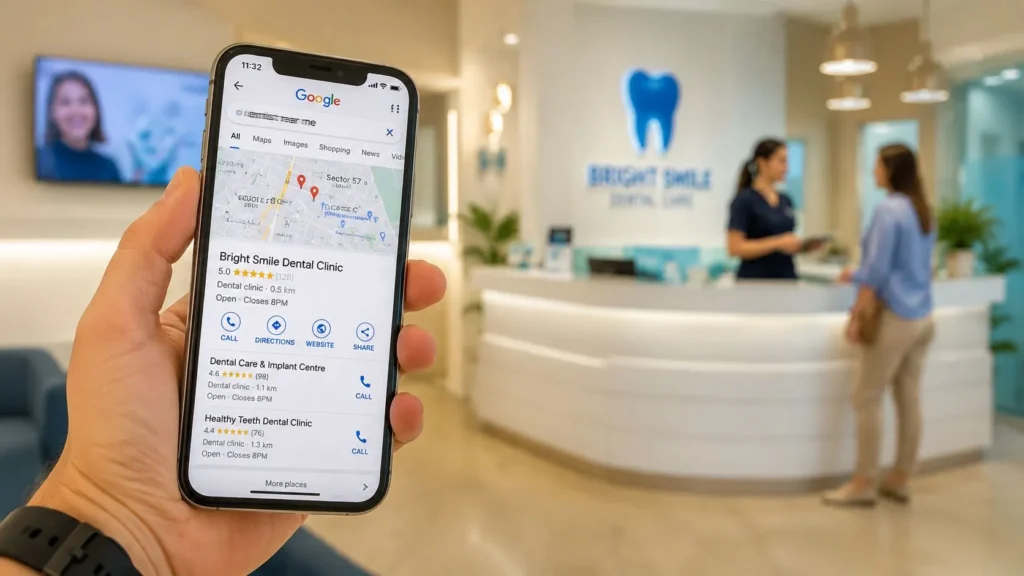
Local SEO is the most important channel for a dental practice. Patients don’t search globally — they search locally. Google Maps results and the Local Pack (the 3 listings that appear above organic results) drive the majority of appointment enquiries for most clinics.
Google Business Profile for dentists:
Your Google Business Profile (GBP) is your single most important local SEO asset. It’s free, it controls what appears in Maps and the Local Pack, and it directly influences whether patients call you.
To optimise your GBP:
- Claim and verify your listing if you haven’t already
- Choose the right primary category: “Dentist” (add secondary categories like “Cosmetic Dentist”, “Orthodontist”, or “Pediatric Dentist” where applicable)
- Fill in every field: hours, services, description, website, phone
- Add 15+ high-quality photos of your clinic interior, team, and equipment
- Enable appointment booking through GBP
- Post weekly updates (promotions, new services, staff features)
- Respond to every review — positive and negative
One common issue I often notice: dental clinics that have moved or changed their phone number but never updated their GBP. That inconsistency hurts your local rankings and sends patients to the wrong number.
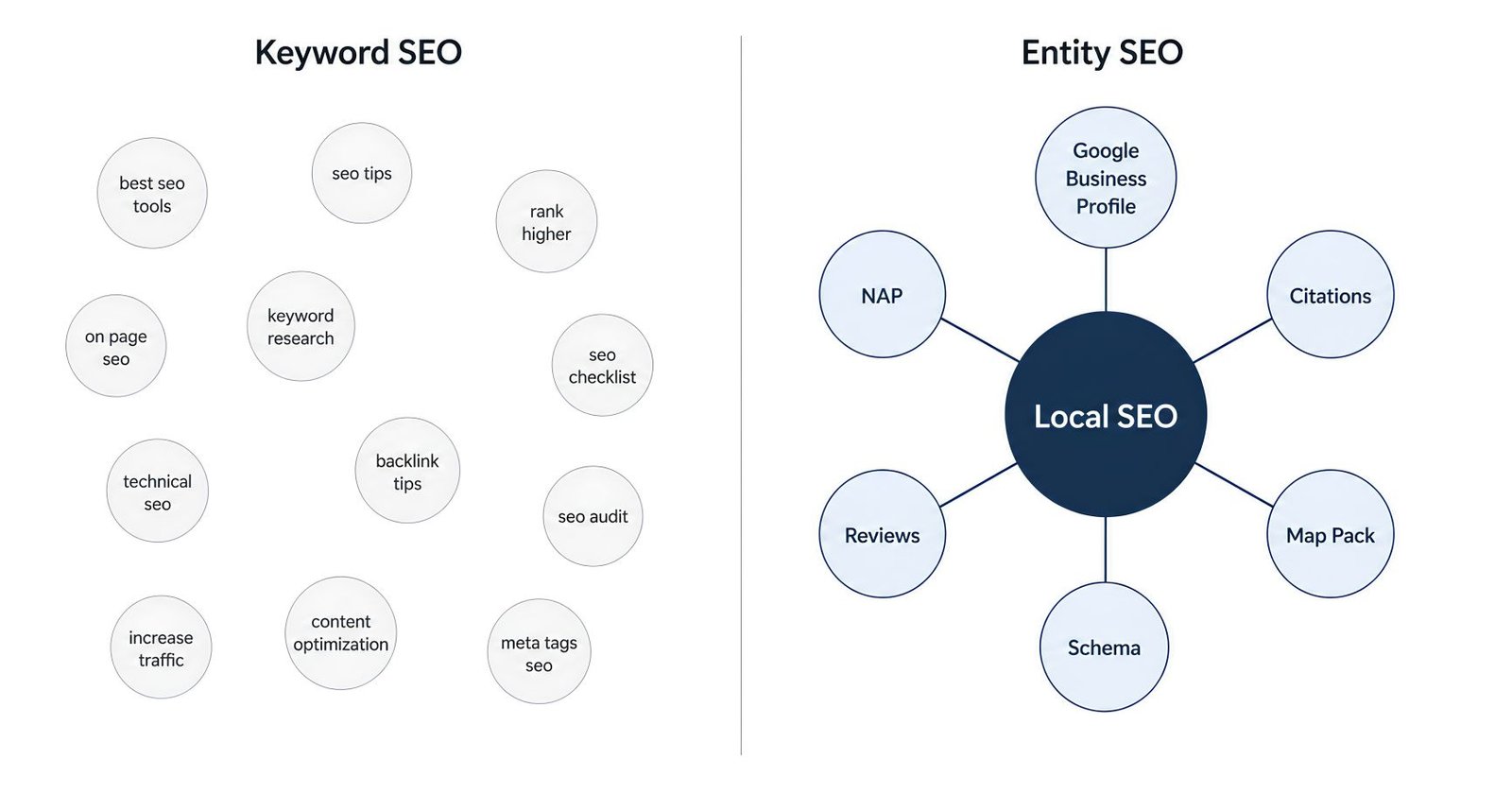
NAP consistency:
NAP stands for Name, Address, Phone. Your clinic’s NAP must be identical everywhere it appears: your website, GBP, Justdial, Practo, Sulekha, Facebook, IndiaMART, and every other directory. Even small differences (Road vs Rd, +91 vs 0) can confuse Google and suppress your local rankings.
Local citations:
Get your clinic listed on:
- Practo
- Justdial
- Sulekha
- Lybrate
- HealthGrades (if applicable)
- Apple Maps
- Bing Places
- Facebook Business
Each listing is a citation signal that reinforces your location and legitimacy for local search.
Google Maps ranking factors:
| Factor | Importance |
|---|---|
| GBP completeness | Very high |
| Review count and recency | Very high |
| Review quality and responses | High |
| Website on-page signals | High |
| Citation consistency | Medium-high |
| GBP post frequency | Medium |
| Proximity to searcher | High (not controllable) |
Step 5: Build a Review Generation System
Reviews are the most direct ranking signal for local SEO. They also convert browsers into bookers. A clinic with 150 reviews averaging 4.7 stars gets significantly more calls than a clinic with 20 reviews, even at the same map position.
Getting reviews requires a system, not luck. The patients who had a great experience rarely think to leave a review on their own. The ones who had a bad experience absolutely will.
What works:
- Send a follow-up SMS 24 hours after an appointment with a direct link to your Google review page
- Train front desk staff to mention the review request verbally at checkout
- Add a QR code at reception that links directly to the review form
- For long-term patients, send a quarterly email with a gentle review request
Never offer discounts or incentives for reviews; Google penalises this. Just ask.
Respond to every review. Thank positive reviewers by name and mention the specific service where possible. Respond to negative reviews professionally and offer to resolve the issue offline. Patients read your responses before booking.
Step 6: Content Marketing for Dental Practices
Content builds topical authority. Google’s way of recognising that your website is a reliable, expert source on dentistry topics. Clinics with strong topical authority rank for more keywords, rank faster, and hold their positions longer.
You don’t need to publish daily. 2-4 high-quality articles per month is enough.
Content types that work well:
- Service explainers: “What Is a Dental Implant and Who Is a Good Candidate?”
- Cost guides: “How Much Do Dental Implants Cost in [City]?
- Comparison posts: “Invisalign vs Traditional Braces: Which Is Right for You?”
- FAQ articles: “10 Common Questions About Root Canals, Answered”
- Local content: “Why [City] Residents Choose [Clinic Name] for Orthodontic Treatment”
Write for patients, not for dentists. Use plain language. Answer the questions your front desk staff hears every day.
Each article should target one primary keyword, include a structured FAQ section (for Google’s “People also ask” feature), and link to the relevant service page on your website.
Step 7: Link Building for Dental Websites
Links from other websites to yours are a ranking signal — they tell Google that your site is trustworthy and authoritative. You don’t need hundreds of links. You need quality links from relevant sources.
For dental clinics, the best link sources are:
- Local business directories and chambers of commerce
- Dental associations and professional bodies (IDA, ADA, BDA depending on your market)
- Local news sites covering community events or health features
- Health and wellness blogs that accept guest contributions
- Supplier and equipment manufacturer sites where you can be listed as a certified provider
Avoid buying links or participating in link schemes. Google’s spam detection has improved dramatically; short-term gains lead to long-term penalties.
Common SEO Mistakes Dental Clinics Make
I’ve seen many dentists struggle with SEO — not because they don’t care, but because they’ve been given bad advice or outdated tactics.
1. Treating the website as a brochure. A static website with 5 pages and no new content will slowly lose ground to competitors who publish consistently. Search engines reward fresh, relevant content.
2. Ignoring mobile experience. Over 60% of local searches happen on mobile devices. If your website is slow to load or hard to navigate on a phone, you’re losing patients before they ever read a word.
3. Not having location-specific pages. If you have multiple clinic locations, each location needs its own page with its own NAP, content, and local keywords. One “Contact Us” page with 3 addresses doesn’t rank.
4. Buying fake reviews. Besides being a policy violation, fake reviews are detectable. Google regularly purges them, and if your account is flagged, you can lose all your reviews permanently.
5. Ignoring the Google Business Profile. A GBP left with default settings and no photos is a missed opportunity. The clinics ranking in the top 3 of Google Maps update their profiles regularly.
6. Targeting only broad keywords. Ranking for “dentist” is nearly impossible for most clinics. Ranking for “dental implants [specific city neighbourhood]” is realistic and often more valuable — the patient intent is clearer.
7. No clear call to action on service pages. Traffic without conversions is wasted. Every page on your website should make it obvious what to do next: call this number, book online, or fill out this form.
Dental SEO vs Google Ads: Which Should You Use?
Both work. The question is timing and budget.
| SEO | Google Ads for Dentists | |
|---|---|---|
| Time to results | 3–6 months | Immediate |
| Cost structure | Monthly retainer or project | Pay per click |
| Long-term ROI | High (compounds) | Lower (stops when budget stops) |
| Best for | Building sustainable patient flow | Fast new patient acquisition |
| Effort | Ongoing | Ongoing |
| Trust signal | Higher (organic = credibility) | Lower (marked as ad) |
| Best services to target | All | High-value: implants, aligners, whitening |
My recommendation: run Google Ads while SEO builds. Ads give you immediate visibility for high-value services while your organic rankings develop over 4-6 months. Once you’re ranking well organically, you can reduce ad spend and maintain lower-cost leads through SEO.
For dental implant marketing and Invisalign/aligner marketing specifically, Google Ads are worth the cost because the patient value (LTV) is high enough to absorb a ₹800–2,000 cost per lead.
SEO for Specific Dental Specialties
Cosmetic Dentist Marketing
Cosmetic dentistry is competitive and visual. Your before/after photo gallery is an SEO and conversion asset — patients search for these images specifically. Optimise image file names and alt text with relevant keywords. Include patient case studies (with consent) on dedicated pages. Target keywords like “teeth whitening cost [city]”, “porcelain veneers [city]”, and “smile makeover before and after”.
Orthodontist Marketing
Parents search for orthodontists when their children are between 9 and 14 years old, and adults search separately for clear aligners. These are different audiences with different content needs. Build separate pages for paediatric orthodontics and adult aligner treatment. Create a comparison page: “Invisalign vs. Metal Braces for Teens”.
Pediatric Dentist Marketing
Parents want reassurance that a paediatricdentists? dental clinic is friendly, safe, and experienced with anxious children. Your content should address parental concerns directly: first dental visit guides, how to prepare a toddler for the dentist, and cavity prevention for kids. Photos of your child-friendly environment perform extremely well on Google Business Profile.
Dental Implant Marketing
Enquiries: Dental implants have the highest patient value of any service. Patients research extensively before deciding. You need content that covers candidature criteria, the procedure step by step, recovery expectations, implant vs bridge comparisons, and cost breakdowns. A single well-optimised implant page can generate 5–10 qualified enquiries per month in a mid-size city.
Tools Every Dental Practice Needs for SEO
| Tool | Purpose | Cost |
|---|---|---|
| Google Business Profile | Local presence management | Free |
| Google Search Console | Track rankings and indexing | Free |
| Google Analytics 4 | Website traffic and conversion tracking | Free |
| Google PageSpeed Insights | Check site speed | Free |
| Semrush or Ahrefs | Keyword research and competitor analysis | Paid |
| Ubersuggest | Beginner-friendly keyword tool | Freemium |
| BrightLocal | Local SEO and citation management | Paid |
| Canva | Social media and review graphics | Freemium |
| Reviewflowz or GatherUp | Automated review request systems | Paid |
You don’t need all of these from day one. Start with the free Google tools, get your GBP fully optimised, and add paid tools once you’re tracking results consistently.
Real-World Example: How We Helped a Dental Clinic Double Their Organic Inquiries
We worked with a multi-chair dental clinic in a city of about 800,000 people. When they came to us, they had a basic website, 14 Google reviews, and no traffic from organic search. Their Google Business Profile was claimed but incomplete — missing photos, services, and a description.
Here’s what we did over 6 months:
- Optimized their GBP fully: 40+ photos added, all services listed, description rewritten with location keywords
- Built 8 new service pages targeting their most profitable procedures with local keyword targeting
- Set up a post-appointment review request system via SMS — reviews grew from 14 to 87
- Fixed 23 NAP inconsistencies across local directories
- Published 2 blog posts per month targeting high-intent local searches
- Earned 4 links from local health blogs and the city’s dental association
Results by month 6: organic website enquiries doubled. Their Google Maps position moved from outside the top 10 to consistently in the top 3 for their 5 most important service keywords. Calls from Google Maps increased by 180%.
None of this was magic. It was consistent execution of the fundamentals.
How Much Does Dental SEO Cost?
Dental SEO costs vary depending on your market, competition, and goals.
| Service Type | Typical Monthly Cost (India) | Expected Timeline |
|---|---|---|
| Basic local SEO (GBP + citations) | ₹8,000–15,000/month | 2–4 months |
| Full SEO retainer (website + content + links) | ₹18,000–40,000/month | 4–8 months |
| One-time website SEO audit | ₹5,000–12,000 | Immediate report |
| New dental website design | ₹30,000–80,000 | 4–8 weeks |
| Google Ads management | ₹10,000–25,000/month + ad spend | Immediate |
A full SEO retainer from a dental marketing agency with real experience typically costs more than the low-end options you’ll find on freelance platforms but the difference in quality is significant. I’ve audited many dental websites that were “SEO optimized” by low-cost freelancers and found no structured data, keyword-stuffed meta titles, and Google Business Profiles that were never touched.
The right metric isn’t cost per month. It’s cost per new patient. If a ₹25,000/month SEO retainer brings you 15 new patients, and your average patient value is ₹8,000, that’s ₹1,20,000 in revenue for ₹25,000 in marketing. Most clinics I work with see that math work out well within 6 months.
Future Trends in Dental SEO and Digital Marketing
AI-powered search is changing how patients find clinics. Google’s AI Overviews now answer many health queries directly in the search results. To appear in these answers, your content needs to be structured clearly, answer specific questions directly, and include accurate, current information. The FAQPage schema markup is more important than ever.
Voice search and conversational queries. More patients are asking Google Assistant or Siri things like “where can I get an emergency tooth extraction near me right now?” These longer, conversational queries favor clinics with detailed, well-structured content. Optimize for natural language, not just keyword phrases.
Video SEO. YouTube is the second-largest search engine, and video results now appear frequently in Google’s main results. A 2-minute video explaining what to expect during a dental implant procedure, embedded on your service page and uploaded to YouTube with proper keyword optimization, can capture both audiences.
Online appointment booking. Clinics that offer direct online booking through their Google Business Profile and website convert a higher percentage of searchers. This is both an SEO factor (dwell time, direct actions) and a patient experience factor. If patients have to call during business hours to book, you’re losing after-hours leads.
Dental reputation management as a competitive advantage. Review quality is becoming a local ranking factor, not just a conversion factor. Practices with higher ratings, more responses, and consistent recent reviews will pull away from competitors who treat review management as an afterthought.
Frequently Asked Questions
1. How long does SEO take to work for a dental clinic? Most dental clinics start seeing meaningful movement in local search rankings within 3–4 months of consistent SEO work. Reaching the top 3 in Google Maps for competitive keywords typically takes 6–12 months depending on your city and competition level.
2. Can I do dental SEO myself or do I need an agency? You can handle some of it yourself — especially Google Business Profile management and review generation. Technical SEO, content strategy, and link building are harder to do well without experience. Many clinics do the basics in-house and hire an agency for the more technical and strategic work.
3. What’s more important: Google Ads or SEO? Both serve different purposes. Google Ads for dentists delivers immediate visibility and is excellent for high-value services. SEO builds long-term organic traffic that costs less per lead over time. If budget allows, run both.
4. How many Google reviews should my dental clinic have? There’s no fixed target, but in most Indian cities, clinics in the Google Maps top 3 have 80–200+ reviews. More important than the number is recency — 10 reviews in the last 3 months outweighs 100 reviews from 3 years ago.
5. What is the Google Business Profile and why does it matter? Google Business Profile (formerly Google My Business) is the listing that appears in Google Maps and the Local Pack. It’s the most visible element of local search for most dental clinics. An optimized GBP directly increases calls, direction requests, and website visits from patients searching locally.
6. Do dental clinics need a separate page for each service? Yes. Google ranks pages, not websites. A dedicated page for “Dental Implants in [City]” will rank independently for that search. Combining services on a single page dilutes your targeting and limits your ability to appear for specific, high-intent searches.
7. What’s the difference between local SEO and regular SEO? Regular SEO focuses on ranking in the main organic results for broad searches. Local SEO focuses on ranking in Google Maps and the Local Pack for location-based searches. For dental clinics, local SEO is usually higher priority because patients are always searching locally.
8. How do I rank higher on Google Maps? Optimize your Google Business Profile fully, build a consistent review generation system, ensure your NAP is consistent across all directories, and have a well-optimized website with location-specific content. These 4 factors drive most of your Maps ranking.
9. Is dental website design important for SEO? Yes. Site speed, mobile responsiveness, URL structure, and clear navigation all affect SEO. A slow, poorly structured website limits how well you can rank regardless of other efforts. Dental website design and SEO should be planned together.
10. What is schema markup and does my dental website need it? Schema markup is code added to your website that helps Google understand your content. For dental clinics, LocalBusiness schema, Dentist schema, and FAQPage schema are the most important. They can help your content appear in rich results like featured snippets and FAQ dropdowns.
11. Should I focus on dental SEO or social media? SEO first for patient acquisition. Social media is valuable for brand awareness, patient retention, and community building but it rarely drives significant new patient bookings directly. Patients don’t browse Instagram looking for a dentist. They search Google.
12. How do I choose the right dental marketing agency? Look for agencies that specialize in dental or healthcare marketing, can show specific results from past dental clients, explain their strategy in plain language, and offer transparent reporting. Be cautious of agencies promising page 1 rankings in 30 days or offering very low-cost packages without clear deliverables.
Final Thoughts
SEO for dentists isn’t complicated, but it does require consistency. The clinics that win on Google are the ones that do the fundamentals well – an optimised Google Business Profile, a fast mobile website with dedicated service pages, consistent reviews, and regular content – and maintain those efforts over time.
The practices I’ve seen fail at SEO almost always share one trait: they treated it as a one-time project. Dental SEO is infrastructure. You don’t install your X-ray equipment and then stop maintaining it. The same applies here.
If you want help building a patient acquisition system around SEO, local search, Google Ads, and dental website design, Bring Brandon works exclusively with clinics and healthcare businesses to do exactly that.
Start with your Google Business Profile. Get your reviews in order. Build service pages that target the searches your patients use. Then build from there.
About the Author
Raghav Dua is the Founder of Bring Brandon, a digital marketing agency focused on SEO, PPC, and web development for businesses that need measurable growth. Since 2019, Raghav has helped 100+ businesses across India, the UK, and North America improve their search rankings, generate qualified leads, and increase revenue through data-driven digital marketing strategy.
He has worked with dental clinics, healthcare providers, e-commerce brands, and professional service firms. His approach focuses on building systems that generate consistent leads rather than short-term traffic spikes.
Connect with Raghav at bringbrandon.com.