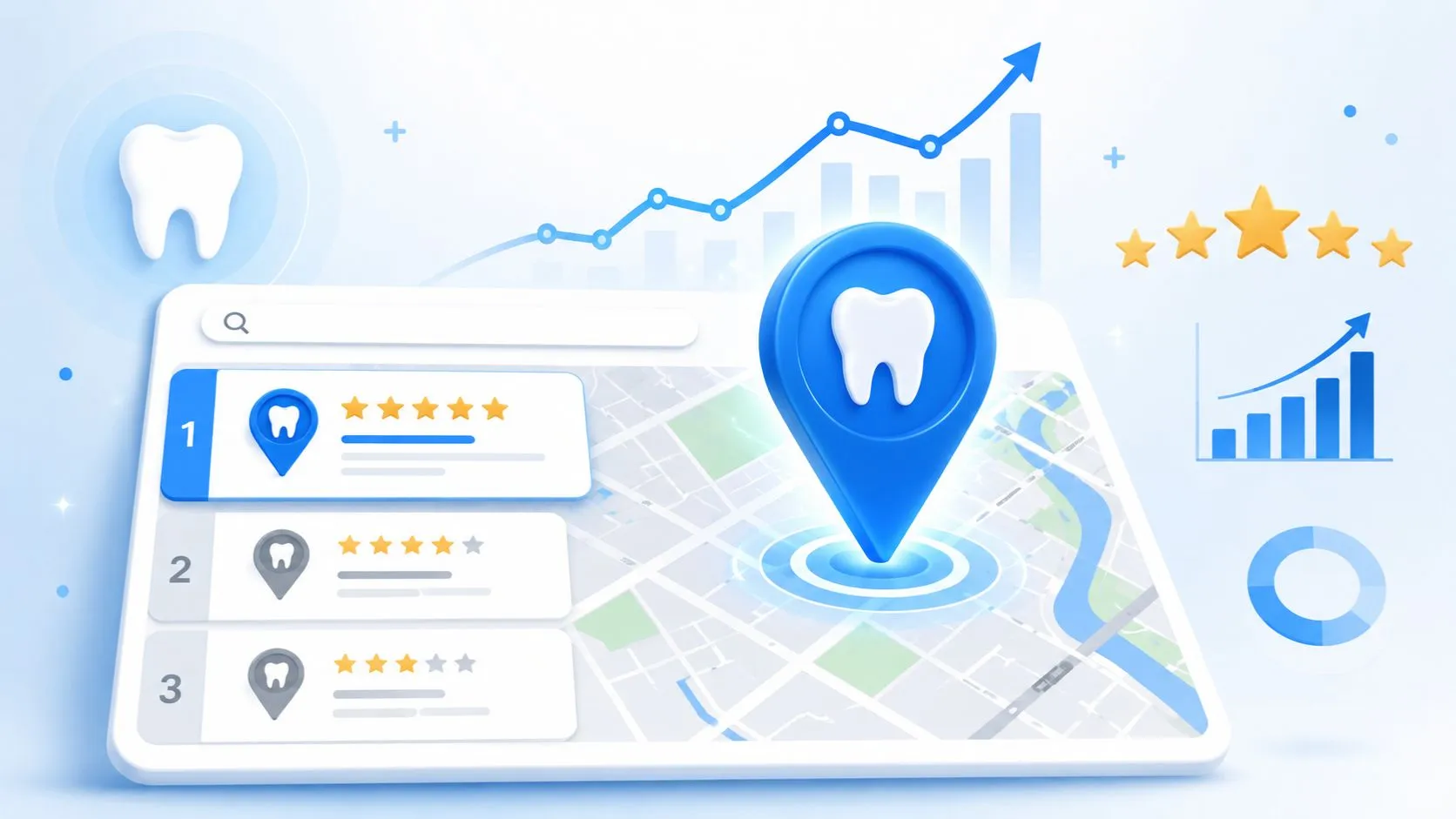

Every month, millions of people type “dentist near me” into Google and choose one of the first 3 results they see on the map. If your clinic isn’t in that top 3, you’re largely invisible to the patients who are actively looking for what you offer right now.
I’ve been working with dental clinics since 2019, and the pattern I see repeat itself constantly is this: a dentist with a great practice, excellent reviews from loyal patients, and years of experience is losing new appointments to a competitor who opened 18 months ago — simply because that competitor shows up higher on Google Maps.
Local SEO for dentists isn’t complicated, but it does require doing the right things consistently. This guide covers everything you need to rank on Google Maps, attract more patients, and grow your dental practice in 2026.
What Is Google Maps Ranking for Dental Clinics?
When someone searches “dentist near me” or “dental clinic in [city],” Google shows what’s called the Local Pack a map with 3 business listings directly below it. These results come from Google Business Profile (formerly Google My Business), not from your website’s organic ranking.
Ranking in this Local Pack is the single highest-leverage thing a dental clinic can do for patient acquisition. The clicks are local, the intent is high, and the person searching is usually ready to book.
Google’s local ranking algorithm uses 3 main factors:
- Relevance: Does your profile match what the person searched for?
- Distance: How close is your clinic to the searcher?
- Prominence: How well-known and trusted is your business, based on links, reviews, and online presence?
You can’t control distance. But you have significant control over relevance and prominence.
Why Google Maps Ranking Matters More Than Ever for Dentists
Here’s a number that should get your attention: 46% of all Google searches have local intent. For healthcare providers, that number is even higher.
When I do SEO audits for dental clinics, I consistently find that the Google Maps listing drives more phone calls than the clinic’s website. Patients aren’t going through a 5-step research process — they search, they see the map, they call.
A few other reasons this matters:
Voice search. When someone asks their phone “find a dentist near me,” Google returns local results. If you’re not in the top 3, you don’t get that call.
Mobile behavior. Over 60% of local searches happen on mobile. People tap the first result. They don’t scroll.
Dental implant marketing, orthodontist marketing, cosmetic dentist marketing — all of these high-value services get searched locally. A patient looking for dental implants in your city is worth potentially thousands of dollars. If your competitor is in the local pack and you’re not, that’s their patient.
Trust signals are visible immediately. Your star rating, number of reviews, and business hours are all visible before the patient clicks anything. First impressions happen at the search result level.
Benefits of Ranking in Google Maps for Dental Clinics
| Benefit | What It Means in Practice |
|---|---|
| More inbound calls | Patients call directly from the listing |
| More appointment bookings | Patients click “Book” without visiting your site |
| Higher trust | 4.5+ star ratings increase click-through rate |
| Competitive visibility | Appear above clinics with larger ad budgets |
| Free traffic | No cost per click from organic local results |
| Voice search inclusion | Captured by “near me” and smart speaker queries |
| Mobile-first visibility | Optimized for how most local searches happen |
Step-by-Step: How to Rank Your Dental Clinic on Google Maps
Step 1: Claim and Verify Your Google Business Profile
This is the foundation of everything. If you haven’t claimed your Google Business Profile (GBP) for dentists, do that first.
Go to business.google.com, find your clinic, and request ownership. Google will send a postcard, call, or SMS to verify you’re the actual business owner.
Once verified, you control what appears in search results.
Step 2: Fill Out Every Section of Your Profile
Most dental clinics leave large sections blank. That’s a missed opportunity because Google rewards completeness.
Here’s what to fill in:
- Business name: Use your real business name. Don’t stuff keywords like “Best Dentist Chicago” — Google can suspend profiles for this.
- Category: Set “Dentist” as your primary category. Add secondary categories like “Cosmetic Dentist,” “Orthodontist,” or “Pediatric Dentist” if those apply.
- Address: Must be exact and match every other place your address appears online.
- Phone number: Use a local phone number, not an 800 number.
- Hours: Keep these current. Nothing kills trust faster than wrong hours.
- Website: Link to your homepage or a dedicated landing page.
- Services: Add every service — teeth whitening, dental implants, Invisalign, root canals, emergency dentistry. Google uses this to match you to searches.
- Attributes: Things like “Accepts new patients,” “Offers telehealth,” “Wheelchair accessible.”
- Description: Write 750 characters that describe your clinic, your specialties, and what makes you different. Include your city name and services naturally.
Step 3: Optimize for the Right Keywords
In my experience working with dental clinics, keyword strategy is where most marketing gets generic. “Dentist” is too broad. You want to be found for what your patients actually search.
High-value keyword targets:
- [City name] dentist
- Dentist near [neighborhood]
- Emergency dentist [city]
- Dental implants [city]
- Cosmetic dentist [city]
- Children’s dentist [city]
- Same-day dental appointments [city]
Use these keywords in:
- Your GBP description
- Your GBP posts
- Your review responses
- Your website’s title tags, H1s, and content
- Your service pages
Step 4: Build NAP Consistency Across the Web
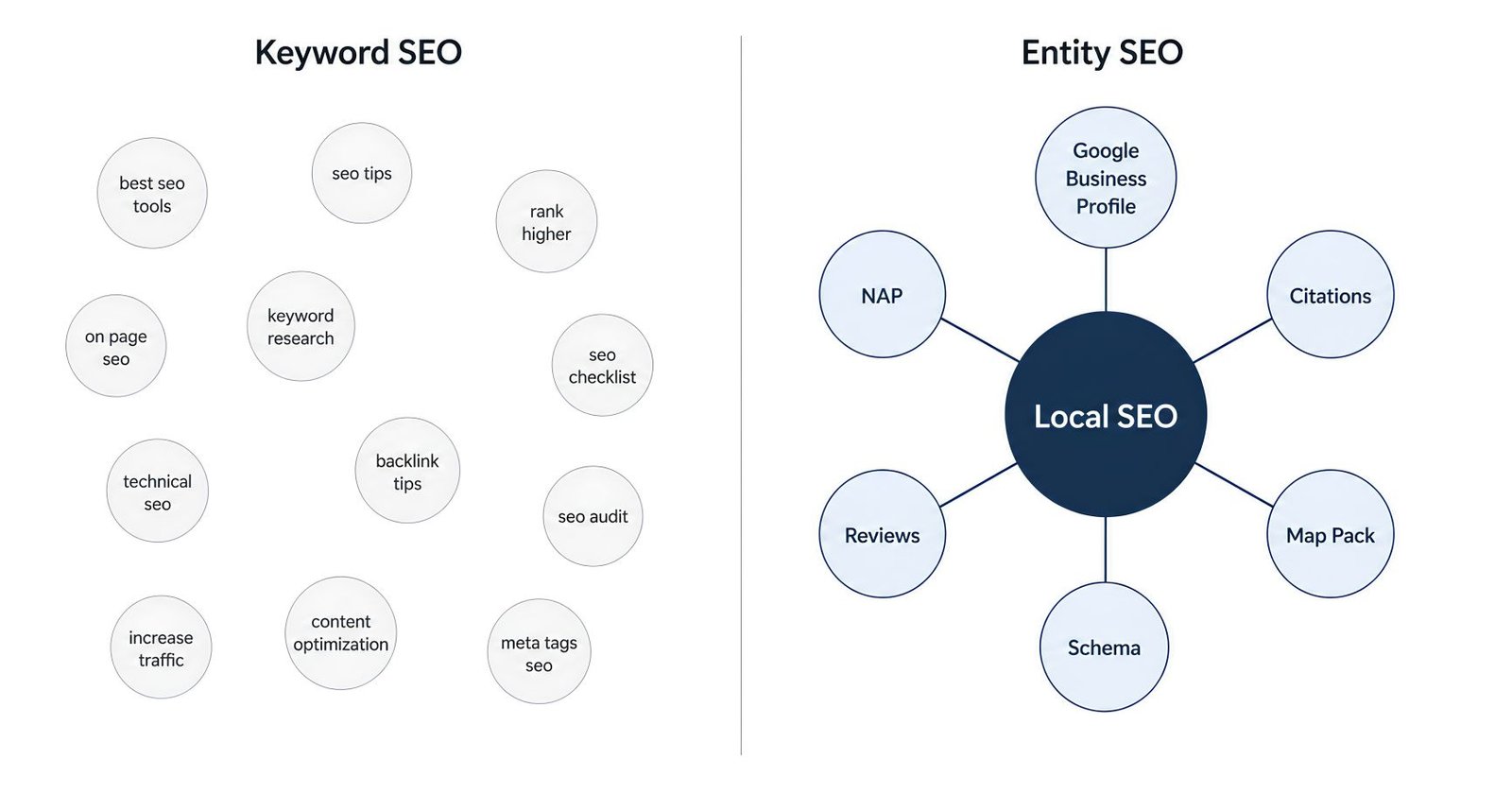
NAP stands for Name, Address, Phone. Google cross-references your business information across the entire web. If your address is “Suite 200” on your website but “Ste. 200” on Yelp and missing entirely on Healthgrades, that inconsistency signals low trust.
Audit and correct your listings on:
- Yelp
- Healthgrades
- Zocdoc
- WebMD
- Vitals
- Apple Maps
- Bing Places
- Yellow Pages
- Local Chamber of Commerce directories
The goal is uniform, exact information everywhere.
Step 5: Generate and Manage Reviews Consistently
Reviews are the most visible part of your Google Maps listing and one of the 3 core ranking factors.
Number of reviews matters. A clinic with 200 reviews ranks better than one with 20, all else being equal.
Recency matters. Getting 50 reviews 3 years ago and nothing since signals inactivity. Google wants to see a consistent flow.
Rating matters. A 4.7-star rating with 150 reviews converts better than a 3.9 with 400.
Here’s what actually works for getting reviews:
- Ask right after a positive appointment. Train front desk staff to say: “We’d love it if you shared your experience on Google — it really helps us.”
- Send a post-appointment text or email with a direct link to your review page.
- Add a QR code at the front desk that goes straight to your Google review form.
- Respond to every review — good and bad. This shows future patients you’re attentive, and it shows Google your profile is active.
For dental reputation management: don’t panic about occasional negative reviews. Respond calmly, professionally, and invite the person to call you to resolve the issue. Never argue publicly.
Step 6: Add Photos and Videos Regularly
Clinics with photos get 42% more requests for directions and 35% more website clicks, according to Google’s own data.
Upload:
- Exterior photos (helps patients recognize the building)
- Reception and waiting area
- Treatment rooms (clean, modern shots)
- Staff team photos
- Before/after treatment photos (with patient consent)
Upload at least 1-2 new photos per month. This signals activity to Google.
Step 7: Use Google Business Profile Posts
GBP posts work like social media posts that appear directly in your listing. Most dental clinics ignore them completely.
Post about:
- Monthly promotions (teeth whitening discount, free consultation)
- New services you’ve added
- Staff highlights
- Patient education content (“What to expect during a root canal”)
- Holiday hours
Post at least once a week. Posts expire after 7 days, so consistency matters.
Step 8: Build Local Backlinks to Your Website
Your GBP ranking is also influenced by your website’s authority. More specifically, how many trusted local websites link back to you.
Ways to earn local backlinks:
- Get listed in your local chamber of commerce
- Sponsor a community event and earn a link from the event website
- Partner with local schools for dental education programs
- Write a guest post for a local parenting blog or community newsletter
- Get listed on dental association websites (ADA, state dental associations)
One common mistake I notice: dentists focus exclusively on their GBP and ignore their website. The two work together. A stronger website lifts your maps ranking.
Step 9: Optimize Your Dental Website for Local SEO
Your website should have:
- Location pages: If you have multiple locations, each needs its own page with unique content.
- Schema markup: LocalBusiness schema tells Google exactly what your business is, where it is, and what it does.
- Fast load speed: Google uses Core Web Vitals as a ranking signal. A slow dental website hurts you.
- Mobile optimization: If your site doesn’t work well on a phone, you’re losing patients before they even call.
- City-specific content: Blog posts like “What to Do During a Dental Emergency in [City]” or “How to Find the Right Pediatric Dentist in [Neighborhood].”
For dental website design, clean and fast always wins over flashy and slow. Patients want to see your services, your team, and a clear way to book.
Step 10: Monitor, Track, and Adjust
Once you’ve done the setup, the work shifts to maintenance and improvement.
Track these metrics monthly:
- Google Business Profile insights (calls, direction requests, website clicks)
- Your ranking position for key local searches
- Number of new reviews and average rating
- Organic website traffic from local searches
Tools like BrightLocal, Whitespark, or Semrush’s local tools make this easier.
Common Mistakes Dental Clinics Make with Google Maps SEO
1. Keyword stuffing in the business name. Adding “Best Dentist” or city names to your GBP business name violates Google’s guidelines and can get your listing suspended.
2. Inconsistent NAP. I’ve seen clinics lose significant ranking after moving and only updating their website — leaving the old address on 30 other directories.
3. No review strategy. Waiting for reviews to come in naturally is too slow. Build a system.
4. Ignoring negative reviews. Silence on a negative review reads as confirmation.
5. Duplicate listings. Multiple Google listings for the same location confuse Google and dilute your ranking signal. Merge duplicates.
6. Wrong primary category. “Dental clinic” is weaker than “Dentist” as a primary category in most markets.
7. No photos. A profile with no photos looks abandoned.
8. Treating local SEO as a one-time setup. Google Maps ranking requires ongoing maintenance: fresh reviews, new posts, updated content.
Local SEO vs. Google Ads for Dentists: Which Is Better?
Both have a role. Here’s an honest comparison:
| Factor | Local SEO | Google Ads for Dentists |
|---|---|---|
| Time to results | 3–6 months | Days |
| Cost structure | Monthly retainer or fixed | Pay per click |
| Long-term ROI | High | Moderate |
| Visibility type | Organic, trusted | Labeled as “Ad” |
| Click-through rate | Higher (organic trust) | Lower (ad label) |
| Sustainability | Results last after stopping | Stops when budget stops |
| Best for | Long-term patient acquisition | Fast patient volume, new clinics |
My recommendation: run Google Ads for dentists while you build your SEO foundation. Once your organic rankings are established, you can reduce ad spend and let SEO carry the load.
We’ve helped clinics cut their paid search budget by 40% over 18 months as their Google Maps and organic rankings improved.
Best Practices Summary
- Verify and fully complete your Google Business Profile
- Build NAP consistency across 20+ directories
- Implement a review generation system
- Add photos monthly and post on GBP weekly
- Build local backlinks from relevant local sources
- Optimize your website for speed, mobile, and local keywords
- Add LocalBusiness schema markup to your site
- Monitor your rankings and GBP insights monthly
Tools and Resources for Dental Local SEO
| Tool | Purpose | Cost |
|---|---|---|
| Google Business Profile | Core listing management | Free |
| BrightLocal | Local rank tracking, citation audit | From $39/mo |
| Whitespark | Citation building, review tracking | From $33/mo |
| Semrush | Keyword research, local SEO tools | From $129/mo |
| Ahrefs | Backlink analysis, keyword research | From $99/mo |
| Google Search Console | Website performance, indexing | Free |
| PageSpeed Insights | Website speed testing | Free |
| Birdeye / Podium | Review generation automation | Varies |
Real-World Examples
Pediatric dental clinic, Midwest city. When we audited this practice, they had 14 reviews, 7 photos, and an incomplete GBP with no secondary categories. Within 90 days of fixing the profile, adding schema markup, and implementing a post-appointment review request via SMS, they went from outside the local pack to position 2 for “children’s dentist [city].” New patient calls increased by 31%.
Multi-location dental group. One common issue I often notice with multi-location practices: all locations sharing the same phone number and similar descriptions. Each location had nearly identical GBP profiles. After creating unique pages, unique descriptions, location-specific content on the website, and separate review strategies per location, 3 of their 4 locations ranked in the top 3 of their respective local markets within 6 months.
Single-dentist cosmetic practice. The dentist had strong organic reviews (4.8 stars) but only 22 of them over 4 years. Competitors had 100+. We built a simple system: post-appointment email with a direct review link, QR code at the front desk, and a gentle ask from the dentist before patients left. Within 6 months: 94 reviews, local pack position 1 for “cosmetic dentist [city].”
What Does Dental Local SEO Cost?
Pricing varies depending on market competitiveness and the scope of work.
| Service | Typical Monthly Cost |
|---|---|
| DIY (your time only) | $0 + significant time |
| Freelancer | $300–$800/mo |
| Dental marketing agency | $800–$3,000/mo |
| Full-service (SEO + Ads + Web) | $2,000–$6,000/mo |
For a dental clinic generating $50,000+ per month in revenue, spending $1,500–$2,500 per month on dental SEO services is often a strong investment if the agency actually delivers results.
What to expect in ROI: A single new patient for a full-mouth treatment plan can be worth $3,000–$15,000 in lifetime value. If a local SEO campaign generates 5–10 additional new patients per month, the ROI is clear even at a $2,000/month retainer.
Ask any dental marketing agency you consider for specific case studies, patient acquisition metrics, and transparent reporting.
The Future of Dental Local SEO
AI Overviews. Google is now surfacing AI-generated summaries at the top of many searches. Clinics that have clear, structured, factual content on their websites are more likely to be cited in these summaries.
Conversational search. As more patients use voice search and AI assistants, longer natural-language queries are becoming common. “What dentist near me accepts Delta Dental and is open Saturday?” Your profile needs to have answers to these questions.
Review quality signals. Google is getting better at weighting review quality, not just quantity. Reviews that mention specific services and staff names tend to carry more weight.
Patient appointment booking integration. Google now allows direct appointment booking through GBP for practices using supported scheduling software. This frictionless path from search to booking converts at a higher rate.
Zero-click searches. More patients are getting everything they need from the search results page — your hours, address, phone number, photos without ever visiting your website. This makes your GBP optimization more critical than ever.
Frequently Asked Questions
1. How long does it take to rank a dental clinic on Google Maps?
For low-competition markets, meaningful improvement can happen in 60–90 days. Competitive markets like major cities typically take 4–8 months to break into the top 3.
2. Do I need a website to rank on Google Maps?
No, but a website significantly improves your ability to rank. Google uses your website as additional evidence of your legitimacy, local relevance, and authority.
3. How many reviews do I need to rank in the local pack?
There’s no exact number. In smaller cities, 30–50 strong reviews may be enough. In major metros, the top 3 often have 100–300+. Match your competitors’ review volume and exceed their rating.
4. Can I rank in cities where I don’t have a physical location?
Google requires a physical address to appear in local results. Service-area businesses can hide their address, but you can’t rank in a city 30 miles from your clinic without a local address there.
5. Does Google Ads spending affect my Google Maps ranking?
No. Paid search and organic/local rankings are separate systems. Running Google Ads won’t boost your local pack placement.
6. What’s the difference between local SEO and regular SEO for dental clinics?
Local SEO targets geographic searches and relies heavily on your Google Business Profile, citations, and reviews. Regular (organic) SEO targets broader search rankings through website content, backlinks, and technical optimization. Both matter for dental patient acquisition; they work best together.
7. How important are photos on Google Business Profile?
Very. Profiles with photos receive significantly more calls and direction requests. Upload high-quality photos of your clinic, team, and treatment areas. Update them regularly.
8. Should I respond to all Google reviews?
Yes. Responding to reviews — positive and negative — shows Google your profile is active and shows patients you’re attentive. Keep responses professional and personalized, not generic.
9. What are citations and why do they matter for dental SEO?
Citations are mentions of your clinic’s name, address, and phone number on other websites (Yelp, Healthgrades, etc.). Consistent citations across authoritative directories tell Google your business is legitimate and help you rank in local results.
10. Can I do dental local SEO myself?
Yes, especially for lower-competition markets. The fundamentals — completing your GBP, building citations, getting reviews — are learnable. Competitive markets or multi-location practices usually benefit from working with a dental marketing agency that specializes in this.
11. What’s the biggest factor in Google Maps ranking for dentists?
Reviews are often the deciding factor between clinics that have done the other fundamentals. Consistent, recent, high-quality reviews from real patients carry significant weight.
12. How does dental website design affect local SEO?
A slow, outdated, or mobile-unfriendly website hurts local rankings. Google evaluates your website as part of its local algorithm. Clean, fast dental website design with local content and schema markup supports your maps ranking.
Final Thoughts
Ranking your dental clinic on Google Maps comes down to a small number of things done consistently: a complete and accurate Google Business Profile, a steady flow of genuine reviews, NAP consistency across the web, and a local-SEO-optimized website behind it all.
None of this is technically complex. The hard part is doing it consistently over months, tracking what’s working, and improving from there.
If you want to handle this yourself, start with your Google Business Profile today. Fill in every field, add photos, and put a review request process in place this week. Those 3 steps alone will move the needle.
If you’d rather have a team handle it — including dental SEO services, Google Ads for dentists, dental website design, and ongoing lead generation that’s what we do at Bring Brandon. We work specifically with healthcare and dental practices and track results against patient acquisition, not just rankings.
Either way, the patients searching for a dentist in your city right now should be finding you.
About the Author
Raghav Dua is the founder of Bring Brandon, a digital marketing agency specialising in SEO, Google Ads, website development, and lead generation. Since 2019, he has helped 100+ businesses improve their search rankings, generate qualified leads, and grow revenue. He works with dental clinics, healthcare providers, and local businesses to build patient acquisition systems that compound over time.